

Bass Scales for Beginners: The 5 Worth Learning First

There are dozens of bass scales to explore, but as a beginner, you only need a few to get started. This guide covers five easy, beginner-friendly bass scales, each with a simple bass tab and a real song example to help you see how the scale works in actual music.
What Is a Scale, and Why Does It Matter on Bass?
A scale is a set of notes played in order, from a starting note (the root) up to the same note one octave higher. Bass lines are built from them. Know a few scales and you stop guessing which notes fit a song and start choosing them.
Two quick terms: a half step is one fret, and a whole step is two frets.
How to read the tabs: each line is a string (G at the top, E at the bottom). The number tells you which fret to press. Play from left to right.
Bass Scales for Beginners #1: The Major Scale
This is the "do re mi" sound, and the base of most music theory. Every major scale follows the same step pattern: whole, whole, half, whole, whole, whole, half (W-W-H-W-W-W-H).
G major (G A B C D E F# G), starting on the 3rd fret of the E string:
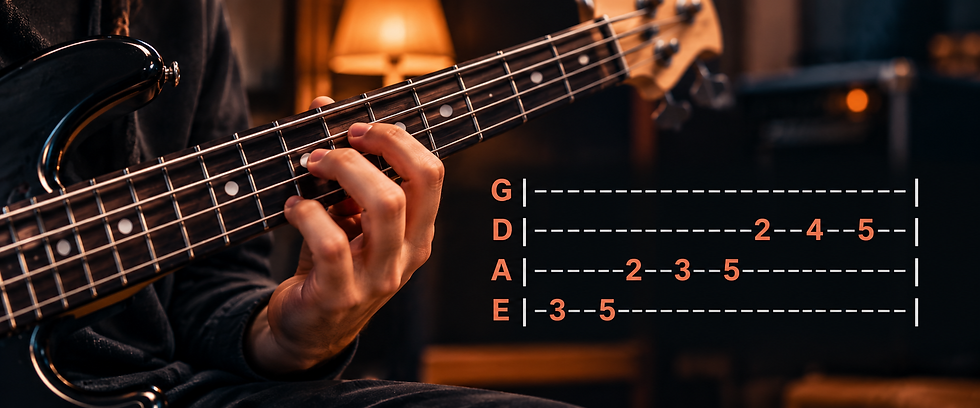
The shape is movable. Slide it up two frets and you are playing A major.
Bass Scales for Beginners #2: The Natural Minor Scale
The minor scale is the darker, sadder-sounding partner of the major scale. Its pattern is W-H-W-W-H-W-W.
A natural minor (A B C D E F G A), starting on the 5th fret of the E string:

A small surprise: A minor uses the exact same notes as C major. The only difference is the starting note, and that changes the whole mood.
#3: The Major Pentatonic Scale
"Penta" means five. This scale takes the major scale and drops the 4th and 7th notes, leaving notes 1, 2, 3, 5 and 6. It sounds bright, and it is hard to hit a wrong note over a major chord.
C major pentatonic (C D E G A C):

Hear it: the famous opening riff of "My Girl" by The Temptations walks straight up the C major pentatonic scale.
#4: The Minor Pentatonic Scale
If you learn only one of these beginner bass scales, make it this one. It is the natural minor scale without the 2nd and 6th notes (formula: 1, b3, 4, 5, b7). You will hear it in rock, blues, funk and pop.
A minor pentatonic (A C D E G A):

Hear it: Queen's "Another One Bites the Dust" is in E minor and is built almost entirely from pentatonic shapes. John Deacon's riff makes a great first song.
#5: The Blues Scale
Add one extra note to the minor pentatonic, the flat 5th (often called the "blue note"), and you get the blues scale. That one note adds a gritty, bluesy tension.
A blues (A C D Eb E G A), with the blue note on the 6th fret of the A string:

Hear it: Cream's "Sunshine of Your Love" started as a bass riff by Jack Bruce, and music writers describe it as built on the blues scale.
How to Practice Bass Scales for Beginners
Go slow. Set a metronome to about 60 BPM and play one note per beat. Speed comes later.
Use one finger per fret. Keep your hand in a four-fret space so each finger covers one fret.
Learn one scale per week. Do not try all five at once.
Use real songs. Scales stick faster when you hear them in music you love.
How AudioRetune Helps You Learn Bass Scales
That last tip is where AudioRetune comes in. AudioRetune is an iOS app that splits any DRM-free song on your device into vocals, bass, drums and other instruments, in real time. It works fully on-device and offline, so your songs never leave your iPhone or iPad.
Solo the bass in "My Girl" or "Another One Bites the Dust" and hear exactly which scale notes the bass player picks.
Mute the bass and play your own line over the band, using the scale you are learning.
Slow the tempo without changing the pitch, so fast runs are easier to follow.
Loop and bookmark one tricky section and play it again and again.
Change the pitch to practice the same scale shape in a new key.
The free version lets you work with four songs from your library every month.
Download AudioRetune on the App Store, load a song you love, and start turning these five bass scales for beginners into real bass lines.


Comments